A tribute · 14 April 1891 — 6 December 1956
Bhimrao Ramji Ambedkar
Jurist. Economist. Social reformer. The principal architect of the Constitution of India — and the moral conscience of a nation still learning to be free.
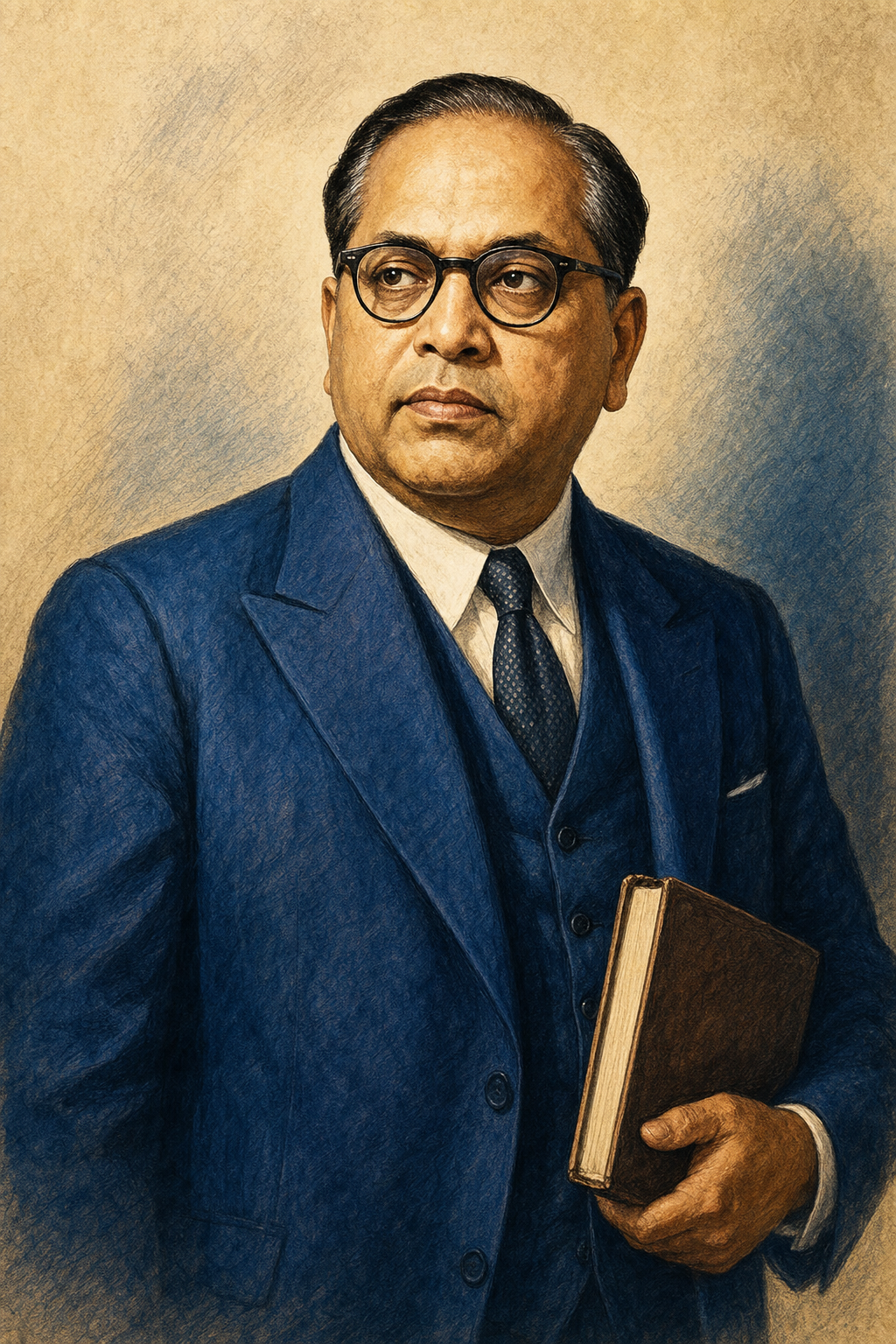
Born into a Mahar Dalit family in the cantonment town of Mhow, Bhimrao Ambedkar rose against a caste order that had declared him unclean at birth. He would earn doctorates from Columbia University and the London School of Economics, qualify as a barrister-at-law at Gray’s Inn, and return to a country that still refused him a glass of water at a public tap.
From that contradiction he built a life of scholarship and struggle — teaching, writing, organising, and, finally, drafting the very constitution that would outlaw the discrimination he had endured. His work is the foundation on which modern Indian democracy stands.
I. A life in dates
A boy from Mhow becomes
a father of the Republic
II. The Constitution
“Constitutional morality
is not a natural sentiment.
It has to be cultivated.”
Between August 1947 and November 1949, Ambedkar chaired the Drafting Committee of seven that produced the world’s longest written constitution.
He gave India universal adult suffrage the moment it became a republic; abolished untouchability by Article 17; guaranteed equality before law.
III. Selected works
A library built
against the current
IV. In his own voice
Words that outlived him
On the 26th of January 1950, we are going to enter into a life of contradictions. In politics we will have equality, and in social and economic life we will have inequality… How long shall we continue to live this life of contradictions?
V. Legacy
The unfinished
Republic
He did not live to see the India he imagined. But every classroom that admits a Dalit child, every court that hears a woman as an equal, every vote cast by a citizen who was once called untouchable — is his monument.
Jai Bhim.